eCloud as a secondary data center: a disaster recovery scenario you can actually test

A traditional second datacenter is an insurance policy with the cost structure of a production environment: servers, storage, networking, licenses, and management for capacity that sits idle most of the time. eCloud offers a different approach to disaster recovery. You pay for the capacity and services you need, without the burden of building and maintaining a second datacenter yourself.
For many mid-sized organizations and local governments, that second location is the weak link in their business continuity plan. Below, you can see how this looks with eCloud, which setup suits which workloads, and where things typically go wrong in practice.
A growth path, not a project
You don't need to set up a fully developed disaster recovery environment on day one. eCloud grows with your continuity strategy, ensuring the solution aligns with the criticality of your applications.
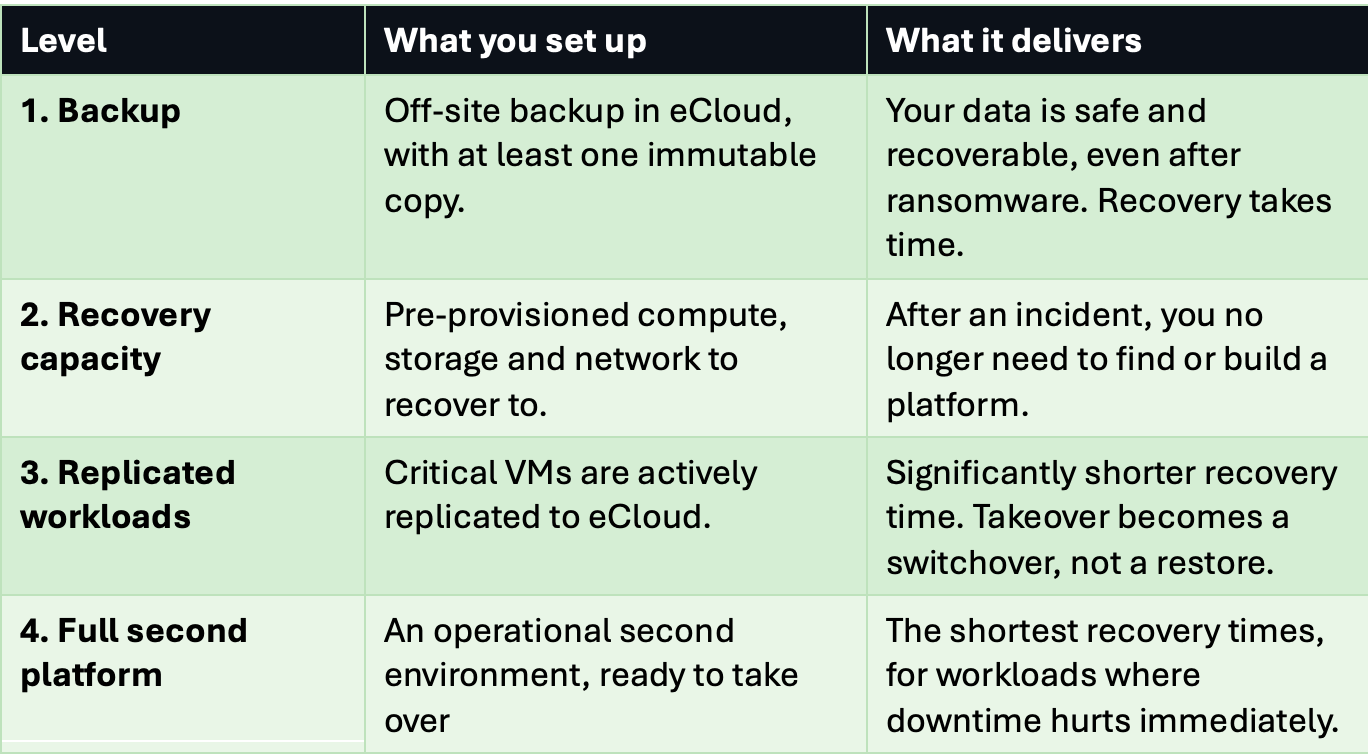
The most important exercise is business-oriented, not technical: determine the acceptable downtime and data loss for each application and weigh that against the cost of guaranteeing it. This leads to a tiered approach. Not everything needs to be at level four, and not everything can remain at level one.
What eCloud has to offer
- Recovery options of your choice. Depending on the architecture, this can be done via Veeam Backup & Replication, virtual machine replication, a pre-configured disaster recovery environment with periodic testing, or a full-fledged second platform.
- Scaling per VM. CPU, memory, and storage are allocated per virtual machine, not per host. You reserve what your recovery scenario requires, not an entire server park.
- Tiered storage. Replicated workloads do not all need to be on the fastest tier.
- Segmented networking. Dedicated segments and address space per customer, firewalling per environment or per VM, and connectivity ranging from site-to-site VPN to a dedicated connection.
- One team for the entire stack. Datacenter, hardware, storage, networking, and Proxmox VE are all managed by Epact. In the event of a failover, you don't have to figure out which party is responsible for the issue.
What remains with you: the decision on RTO and RPO per application. Epact advises, designs, and helps build, but the risk assessment lies with the business, as that is where the consequences are felt.
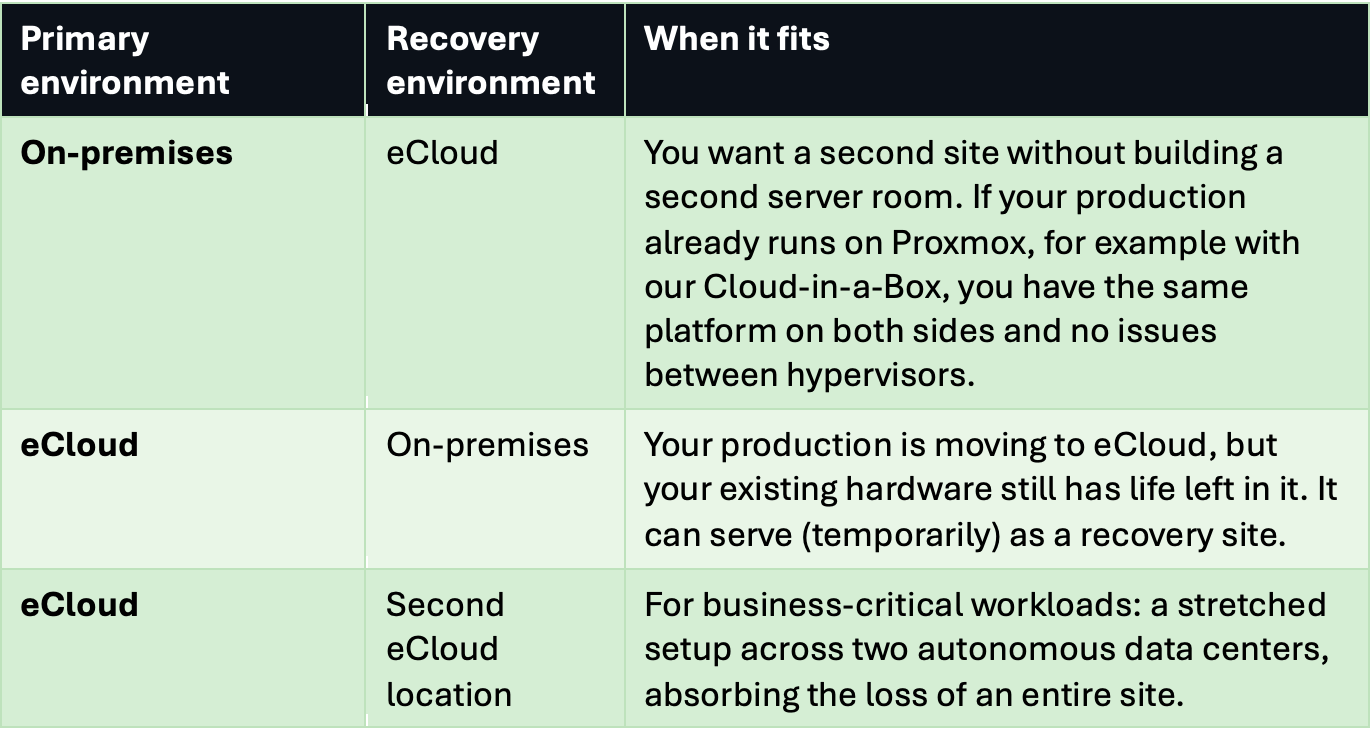
Three directions for your disaster recovery site
Our model works in both directions. Which variant makes sense depends on where you stand today and the investments you have already made.
Four questions to get started
- Downtime: how many hours can each critical application be down before it truly impacts the business?
- Data loss: how much is acceptable? A backup from last night means redoing a full day's work.
- Recovery target: where are you recovering to, on what hardware, in which data center, and is that capacity already available?
- Testing: when was it last tested, and what were the results?
If you cannot answer these four questions clearly, that is your starting point. Our experts are happy to translate your answers into a concrete disaster recovery scenario, with a realistic assessment of RTO, RPO, and costs.